Vancouver Sun: ART SEEN: Everything from the beautiful to the disturbing is in Drama Queer

Kevin Griffin • Published June 30, 2016

Drama Queer is a mass of contradictions — and that’s exactly as intended.

It has works that are both utterly beautiful and shockingly disturbing. It has provocative political works and quieter intimate works. It also has works that are designed to evoke an emotional response in the viewer.

Drama Queer is easily one of the best art exhibitions of the year in Vancouver. It’s a shame it’s only up for nine days. Drama Queer is on display until later today — Wednesday, June 29th — not Thursday, June 30 as previously indicated. The exhibition ends at 10 p.m.

There are outstanding works by local artists and a lot of work by artists from the U.S. and Europe that I’ve never heard of or seen before. Works in different mediums are treated with an egalitarianism that’s rare in Vancouver. Contemporary painting which usually has to fight for its critical existence here is given a place alongside works in other mediums such as photography, video and text-based works.

As well, the didactic panels are well written, understandable and devoid of art talk. For the most part, they convey just the right amount of information to put the works in context and help viewers understand what’s in front of them.

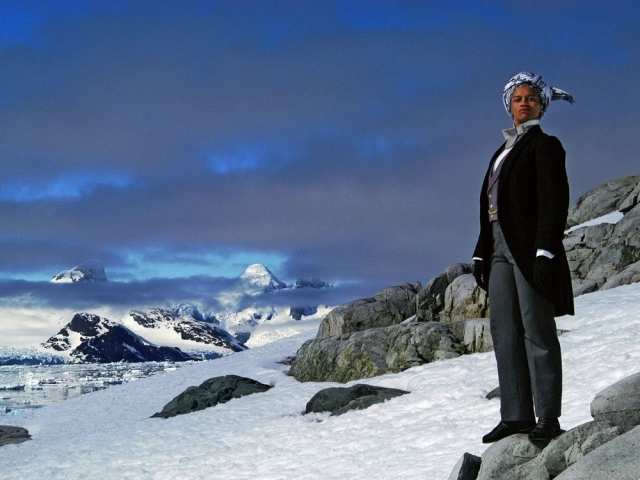
Drama Queer sets its tone right at the start with three photographic works by Del LaGrace Volcano. The one I found most powerful shows the face of an African-American woman in tears wearing men’s formal clothing from the 19th century. Inspired by the story of an American slave who passed not only as a man but also as white, the portrait captures what it must be like for someone to be trapped in socially-constructed blackness.

Hips by Andrew Holmquist in Drama Queer. Vancouver Sun

The exhibition includes three epic historical paintings by Attila Richard Lukacs inspired by the second U.S.-led second war against Iraq. Of the three, my favourite is 7 Devils Dead, a painting full of soldiers, devils, weapons and young men.

In the left foreground are a group of four U.S. soldiers. One without a helmet looks directly at the viewer with knowing eyes as he holds a grey gun, the vertical barrel and colour echoing oil derricks in the landscape behind. The gun is connected by a drip to a pink skeleton of death floating cavalierly on its side in the space above. His skull is a cigarette ashtray. Over its head written in text designed to look like smoke is the ironic phrase ‘Why Can’t I Quit Smoking.’

Strapped to the skeleton’s left arm is a hockey stick that morphs into another gun which shoots a bullet and rips apart the chest of a man swinging a cricket bat riddled with bullet holes that spells Git Mo. Below, a naked young man looks like he might be flying is led away by a blue devil. The naked youth’s right leg is caressed and maybe held back from death by another U.S. soldier who has an erect penis in place of his right arm. On a chain, the soldier has a tombstone that reads ‘My Beloved Boner RIP.’ It’s a great painting that not only acknowledges the homoerotic appeal of all-male environments but also the deadly consequences of being at war against other men.
I found myself lingering for several minutes on three photographs by Laura Aguilar. They’re abstracted portraits of the artist’s fleshy, Rubenesque body in a desert-like landscape.
Grounded 107 shows the artist lying on her side on a grey boulder. I had an immediate response to seeing her soft flesh on top of a hard surface: it produced a sensation that rippled down the back of my neck. I could feel the rough hardness of the stone against my skin.

Aguilar has abstracted her body so much that I couldn’t tell which end was which. Was the limb extending down into a dark cavity her leg or her arm? Aguilar’s self-portraits deny showing her face as one of the usual markers of individual identity. Their setting also made me think of the desert paintings of Georgia O’Keeffe.

Just What Is It About Today’s Homos That Makes Them So Different, So Appealing by Joey Terrill in Drama Queer at the Queer Arts Festival, 2016 [PNG Merlin Archive] Vancouver Sun
Kent Monkman has a wonderful work in the exhibition called Dance of the Berdache. It’s a five channel video projected onto synthetic buffalo hides in the main exhibition hall. The work is an exploration of identity and how the contemporary idea of ‘Indian’ is a mixture of old and new, past and present, western and indigenous. Accompanied by a soundtrack of traditional aboriginal singing along with orchestral music, it features indigenous dancers performing a mix of movement styles from Hollywood, acrobatics and indigenous traditions. In the centre, Monkman performs as Miss Chief Eagle Testikle. She’s a cross-dressing berdache who, as Monkman has said, “looks back at European settlers.”

As artist Paul Wong pointed out to me, showing Monkman’s video in The Roundhouse works far better than showing it in a traditional white cube. The Roundhouse was originally part of a complex of buildings designed to service the original steam trains which brought settlers to the western terminus of the CPR. The Roundhouse is a building whose history embodies the colonialism that inspired Monkman’s video.

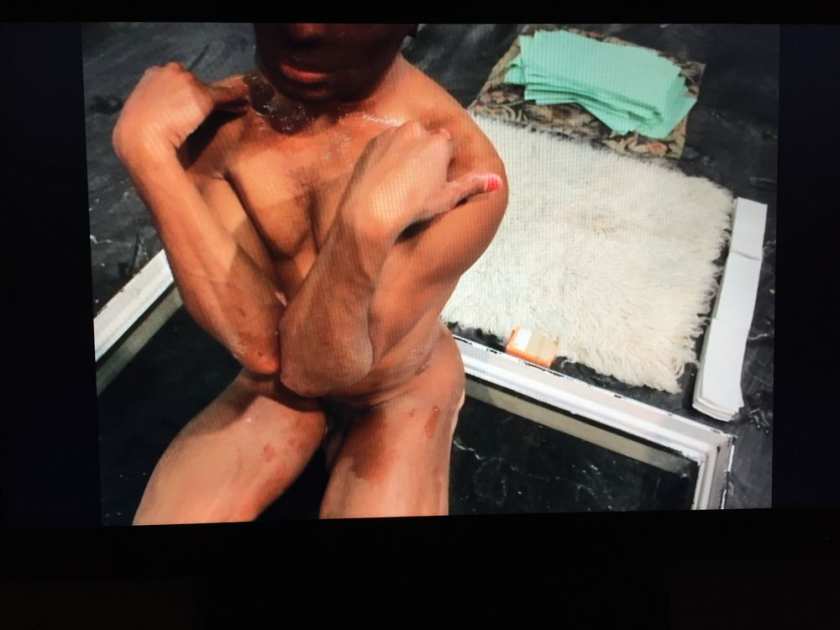
There were many other works that stood out in the exhibition. One of Joey Terrill’s paintings (above and detail below) takes its title from the collage by Richard Hamilton that’s often called the first example of pop art. Terrill’s Just What Is It About Today’s Homos That Makes Them So Different, So Appealing depicts examples from his daily life as a Mexican-American living in Los Angeles. Sharing the canvas with a playful presentation of sex, AIDS pills and various consumer items such as a bottle of Coca-Cola are several monarch butterflies which symbolize the Chicano community. In a few expressive but controlled gestures of paint in lime green, Andrew Holmquist combines both masculine and feminine in Hips (above). Photographs of Cassils record a performance by the transgender artist when she attacked a 300-pound pile of clay. Her insanely muscular and ripped body is the result of working out for two years. Keijaun Thomas’s slow, methodical almost ritualistic movements in his video installation The Poetics of Trespassing (detail above) were hypnotic and powerful. The video depicts the harshness of racism by softness when the brown skin on the artist’s back and shoulders is covered with a dusting of white flour.

The exhibition also included works that I found difficult to look at.

One in particular is from series of erotic photographs by George Steeves, a Nova Scotia artist who identifies as straight. One of them shows an older man seated awkwardly at the bottom of a banister. He’s naked and has a big erection that parallels the verticality of the posts on the stairway.
The photograph provoked a response because it made me confront my own fears of aging and sex. It was his expression that I found particularly disturbing: he appeared totally possessed by his fetish. With his missing and blackened teeth, he no longer looked human. He looked like a ghoul.
The one work that I found by far the most troubling was Naked Boy Cutting by Andreas Fuchs. It shows a naked young man with several piercings and tattoos in the moments after he’s cut his left arm. He’s bleeding profusely. As a photograph it reads as a document of an event in a pristine white environment.

The didactic panel says that the photo embodies the contradictory drives of masochism and sadism in one person. The young boy is both the active partner inflicting pain and the passive partner receiving it. Although it’s difficult to get inside the mind of someone, the description seems a fair one. He looks as if he’s amazed at what he’s done to his body.

This is one case where more information would have been helpful. It wouldn’t have reduced my visceral reaction to the photograph, but it would have helped to know how this one image fit into the artist’s other work and whether the one in the exhibition was part of a series. On its own, it looks provocative for its own sake.

As well, I kept thinking about the relationship between the model and photographer. Was there a sense that the model was performing for the camera and making the wound deeper and more dramatic for a ‘good’ picture? Did the photographer ask for a deeper cut to produce more blood? The photograph was so foreign to my own experience that it both fascinated me and repelled me.

Drama Queer is curated by Jonathan D. Katz, one of the leading queer art historians and curators in the U.S. He’s an associate professor and director of the doctorate program in art history/visual studies at the State University of New York at Buffalo. I’ve written previously on both Drama Queer and Katz.

Drama Queer is part of the Queer Arts Festival. The art exhibition ends today while the festival continues to June 30th.

Detail from Just What is It About Todays Homos That Makes Them So Different, So Appealing by Joey Terrill in Drama Queer. Vancouver Sun

*Grammatical corrections made Thursday, June 30, 2016. See original article here.
Vancouver Sun: Drama Queer exhibit aims to forge emotional connection

Kevin Griffin: Published on: June 15, 2016

In the contemporary art world, the language used to talk about art is often as dull as a quarterly corporate report. It steers clear of poetry, devalues emotion and elevates dry intellectual concerns above all others.

The idea that a work of art might want to provoke a strong response or that someone might feel something is often considered a sign of failure in the art and weakness in the viewer.

Jonathan D. Katz, a leading U.S. art historian, challenges that notion with an art exhibition at the Queer Arts Festival. Drama Queer looks at emotion and emotional engagement as an alternative to the traditional intellectual and formalist understanding of art that has come to dominate the art world.
Katz said the idea for the Drama Queer came indirectly from a 1966 essay by Gene R. Swenson for an exhibition called The Other Tradition on the overlooked role of emotion in modern art. Katz said while almost all the artists chosen by Swenson were gay or lesbian, Swenson couldn’t talk about sexuality because of the era’s homophobia. But since then, society has changed so that scholars such as Katz can specialize in studying where art history and queer history overlap.

“We have stinted attentiveness to emotion in favour of intellectual and formal qualities,” said Katz, an associate professor at the State University of New York at Buffalo.

“I wanted to return to it because fundamentally our response to art is, so often, but not always, emotional.”
Drama Queer is framed in a queer context that might appear to exclude people who don’t define themselves as queer, a word that was once exclusively pejorative but is being reclaimed and used to describe not only lesbians and gays but people of all genders who transgress traditional ideas of normalcy. But Katz said the exhibition is also about what we share in common such as concerns about personal security, happiness and love.
Even if viewers consider themselves straight, he hopes the work will emotionally connect with people. Queer emotions, he said, are contradictory: they’re both different from and similar to what everyone else experiences.

“Very often we have a misunderstanding of our emotional relationship with others so that if they don’t reflect us we don’t see ourselves in them,” he said.

“This show is about how those who might be quite other in many respects reflect us.”

As an example, he cited Moj of the Antarctic. The photographs in Drama Queer are based on Mojisola Adebayo’s one-woman play that was inspired by Ellen Craft, a 19th-century African-American slave who passed not only as white but also as a man.

One of the photos shows a close-up of the face of Moj wearing a top hat and formal men’s clothes with tears streaming down her blackface.

Grounded by Laura Aguliar is in Drama Queer. Vancouver Sun
The photographs were shot in Antarctica by Del LaGrace Volcano, a self-described “gender abolitionist.” Born with male and female characteristics, Volcano lived for 37 years as a woman and now lives as both male and female.

“It’s a series of works of someone who is born black, who is literally in an (Antarctic) landscape, all white, and is in blackface and crying,” Katz said about Moj of the Antarctic.

“So often we live emotional lives that are either performed for others or that we seek sort of sequester or hide ourselves behind a facade. I think people will come to understand, especially as they move through the exhibition, how often the emotional realities that simmer just beneath the surface of appearance are actually the defining ones.”

Katz doesn’t believe sexuality is in and of itself enough for an art exhibition. It needs to be linked to other forms of identity such as ethnicity, gender and class.

“One of the things I’m very proud of is that my notion of queerness is one that seeks to decentre hetero-normativity but it doesn’t depend on what you yourself as an artist practise,” he said in a phone interview from Buffalo.

“I love it when straight people make queer art.”

Katz is arguably the best known queer art historian and curator in the U.S. One of the highest profile exhibitions he co-curated was the groundbreaking Hide/Seek exhibition in 2010 at the Smithsonian Institution’s National Portrait Gallery in Washington, DC. Hide/Seek was the first time a major U.S. art museum looked at sexuality and its influence on modern American portraiture. But the show led to complaints by a Roman Catholic group and Republicans in Congress over a film that showed ants crawling on a crucifix by David Wojnarowicz. The Smithsonian succumbed to pressure and pulled the film from the exhibition.

7 Devils Dead by Attila Richard Lukacs is one of more than 80 works in Drama Queer in the Queer Arts Festival at The Roundhouse Community Centre. Vancouver Sun

Katz was asked to curate an exhibition at the Queer Arts Festival by artistic director SD Holman when he was in Vancouver last year for a panel during the The Mainstreeters art exhibition.
Katz said yes to Holman because of the freedom the Queer Arts Festival would give him in picking a theme.

“I tend to do lots of exhibitions, but I tend to work with big museums and big museums have requirements,” he said.

“There was a lot of freedom associated with the arts festival that I appreciated. For this one I wanted a wide open, complicated and chewy topic. I wanted one that offered lots of points of purchase for Canadian, U.S. and European artists. That’s exactly what we have.”

Drama Queer features more than 80 paintings, photographs and sculptural works by 23 artists, some whose work is well known but many who will be showing in Vancouver for the first time. Artists in the show include Cassils, Joey Terrill, Laura Aguilar and Monica Majoli along with Attila Richard Lukacs and Angela Grossmann from Vancouver, Kent Monkman from Toronto and 2Fik who is from Morocco and France and now lives in Montreal.

Katz said even though emotion is often discredited, even by activists, it can be the most effective way of political engagement.

“If you can affect a change in an individual internally, then you’ve got them,” he said.
“Whereas if you just convey a slogan, you may have their immediate attention, but you won’t have changed anything. It’s the emotional experiences that people remember and live with.”
Drama Queer: Seducing Social Change is part of the Queer Arts Festival 2016. The exhibition opens Tuesday, June 21 and continues to Thursday, June 30 at The Roundhouse Community Centre. Katz will be on a curator panel Wednesday, June 22 at 7 p.m. at The Roundhouse.

View original article here

ART SEEN:

Jonathan D. Katz’s quest to queer the art world one exhibition at a time

Vancouver Sun – Kevin Griffin – June 21, 2016

Click here to watch the video: http://vancouversun.com/news/staff-blogs/art-seen-jonathan-d-katzs-quest-to-queer-the-art-world-one-exhibition-at-a-timeIn 2005, Jonathan D. Katz curated a unique art exhibition at Yale University’s art gallery.

On display were works by artists such as Charles Demuth, Marsden Hartley, Robert Rauschenberg, Jasper Johns, Cy Twombly, Louise Nevelson, Robert Indiana and Andy Warhol. The exhibition was unique because all the works were by American gay and lesbian artists from the Yale University art collection.

Night Out: Yale University Celebrates a Legacy of LGBTQ Artists didn’t last long. Yale told Katz it could only be up for one evening.

“I wanted to make a point that there was an alternative history that could be told and what the museum elected to tell was, in some sense, premised on inattentiveness to questions of sexuality,” he said.

“I’m not saying that sexuality is the only story in art that needs to be told. I’m just saying it’s a story that’s not been told and that museums won’t tell.”

The exhibition coincided with the end of funding for the Larry Kramer Initiative for Lesbian and Gay Studies of which Katz was executive director.

“You probably picked up my mixed tone,” he said.

“I’m incredibly grateful that Yale allowed me to tell that story with their collection and I’m also unhappy that it was only for one day.”

Katz is an art historian at the State University of New York at Buffalo. As a scholar, he’s interested in the intersection of art history and queer history. Historically, queer was a pejorative word but it has changed over time and is now being reclaimed and used to describe not only gays and lesbians but also gender non-conformists and others who consider themselves at odds with definitions of normalcy.

I was interviewing Katz because he’s the curator of Drama Queer, the art exhibition at the Queer Arts Festival which opens today at the Roundhouse Community Centre.

His work puts him at the forefront of art historians and curators studying art from a queer perspective. Because of his huge expertise American art history and LGBTQ issues, I wanted to ask him about more than Drama Queer.

I had come across the story of the one-day queer art show at Yale in a speech given by legendary AIDS activist and playwright Larry Kramer to the school’s Gay and Lesbian Association. Kramer explained that in 2001, his brother gave $1 million to the university to set up the Larry Kramer Initiative. Katz’s queer art show took place when the funding for LKI was coming to an end.

Katz said the disappearance of LKI came down to the university not liking his kind of interdisciplinary program in the Women’s and Gender Studies Department.

“We were a free radical and the one thing Ivy Leagues are worried about are free radicals,” he said by phone from Buffalo.

“We had to be made official. When I was there, they hired a queer historian in the history department. (Yale) moved it into the traditional departmental structure which makes universities much happier because then they operate with levels of containment and control.”

Katz is one of the leading queer art curators in the U.S. His exhibitions have included exploring the relationship between Robert Rauschenberg and his gay lover Jasper Johns and the politics of camp. As well, he was guest curator for the groundbreaking exhibition Hide/Seek: Difference, Desire and the Invention of Modern American Portraiture for the Smithsonian Institution’s National Portrait Gallery. Hide/Seek was the first time a major U.S. art institution looked at the relationship between art and sexuality in an exhibition. More recently, he co-curated the exhibition Art AIDS America on how AIDS changed American art.

Katz is also president of the board of trustees of the New York’s Leslie-Lohman Museum of Gay and Lesbian Art,* the first art museum dedicated to showing the work of gay and lesbian artists.

Jonathan Katz is curator of the art exhibition Drama Queer at the Queer Arts Festival, Vancouver, June 21 to 30, 2016. Katz is associate professor at the State University of New York at Buffalo.
Jonathan Katz is curator of Drama Queer at the Queer Arts Festival. Katz is associate professor at the State University of New York at Buffalo. ‘ 2013 University at Buffalo / Vancouver Sun

Besides curating queer art exhibitions, he’s also writing a book with a provocative title: The Homosexualization of American Art: Jasper Johns, Robert Rauschenberg and the Collective Closet.

The book looks at what Katz describes as a “curiously understudied aspect of U.S. modernism”: the period when the aggressively heterosexual abstract expressionists led by artists such as Jackson Pollock and Willem de Kooning of the 1950s were replaced by a generation of almost entirely queer artists such as Johns, Rauschenberg, Cy Twombly, and Andy Warhol in the 1960s.

“I’m looking at the shift from one generation to another and how it came to pass, broadly speaking, that queer artists represented America to itself,” he said.

Katz said he’s spent years researching and writing the book which will be published next year.

“I have been bedevilled in writing the book, for example, by reproduction rights. It is not something people pay attention to but the fact of the matter is that when you’re writing an art history book you have to get permission from artists or from artist’s estates.

“Until recently, that permission was very hard to get if was around, for example, sexuality. Even the most successful artists were worried about the revelation about their sexuality.”

Katz recalled a conversation he had with Elsworth Kelly about getting art work for the Hide/Seek exhibition. Kelly was a hard-edge abstract painter as well as a sculptor and printmaker. He died last year. In 2014, a painting by Kelly sold for $4.47 million US at Christie’s.

“’You’re going to destroy my prices,’” Kelly told him.

“I’m thinking: ‘My god, you’re Elsworth Kelly and you’re worried about that.’ But that’s evidence of how deep the scars from the 1950s run.”

Katz’s Drama Queer is showing work by European, American and Canadian artists. The exhibition includes paintings by Vancouver artist Attila Richard Lukacs.

“I don’t think he would object if I called them antiwar paintings,” Katz said. “I embarrassed him when I praised him.”

Katz said Drama Queer is a museum-quality show that is only up for 10 days because that’s the duration of the Queer Arts Festival. Most exhibitions he curates are usually on display for several months.

“One of the things that I’ve been on a crusade for is to make the world safe for queer exhibitions in mainstreams museums.”

Despite the fact that queer-themed exhibitions generate lots of interest and high attendance, he said, museums are terrified of presenting them.

“Because fundamentally, at least in the U.S., decisions are made not by the attendance of these exhibitions — that’s not what makes an exhibition valuable,” he said.

Because directors on boards of museums are the big collectors with big money, they’re the people with the greatest influence on programming.

The contrast between Canada and the U.S. in terms of the source of funding is striking. One Canada Council study (admittedly with dated information from 2005) said that per capita public funding for all the arts in Canada amounted to about $56 per person compared to $7.14 in the U.S.

The Museum of Modern Art in New York, for example, has raised $858 million for its new building: $500 million privately from pledges of board trustees and $65 million from the City of New York.

“You can say and write anything you want about poetry because there isn’t big money in poetry,” he said.

“But there is very big money in art. The social class that is in a position to fundamentally influence the museum world is currently standing at the top of the social hierarchy. They’re not going to embrace things by and large that are going to threaten that position.”

Drama Queer opens today, Tuesday, June 21, and continues to Thursday, June 30 at The Roundhouse Community Centre. Drama Queer is part of the Queer Arts Festival.

Fagger Rangers vs Musulmen by 2Fik is part of Drama Queer during the Queer Arts Festival 2016 at the Roundhouse Community Centre. [PNG Merlin Archive]
Fagger Rangers vs Musulmen by 2Fik is part of Drama Queer during the Queer Arts Festival 2016 at the Roundhouse Community Centre. [PNG Merlin Archive] Vancouver Sun

*Correction to title Wednesday, June 22, 2016.

Vancouver’s Queer Arts Festival 2016 to explore emotion in art and activism

by Craig Takeuchi, Georgia Straight, March 15th, 2016

Vancouver’s Queer Arts Festival continues its dedication to LGBT art and social progress with the theme of the 2016 edition of the festival. That commitment is further underscored by the change of its dates this year from August to the Stonewall season in June.

This year’s QAF visual art exhibition will explore what role emotion plays in queer art as political activism.

Drama Queer: Seducing Social Change will be curated by New York–based queer studies scholar Jonathan D. Katz.

The exhibition will centre around three paintings by Vancouver artist Attila Richard Lukacs, and will include work by international artists, including Angela Grossman, Bill Jacobson, Vika Kirchenbauer, Alice O’Malley, Del LaGrace Volcano, and more.

Australian composer Lyle Chan’s An AIDS Activist’s Memoir will be performed at the 2016 Queer Arts Festival.

Another politically charged festival highlight is An AIDS Activist’s Memoir, performed by the Acacia Quartet and narrated by Australian composer Chan, who conceived of the work during the height of the epidemic.

Art and social politics will be further explored in Buddies in Bad Times and frank theatre production The Pink Line, a new play about the history of art, activism, and racism.

Queer Noise will offer an evening of short film, video, and media art performances by artists such as Kami Chisholm, Rémy Huberdeau, Elle-Máijá Tailfeathers, Larose S. Larose, Blaire Fukumura, Scott Fitzpatrick, Elisha Lim, and more.

Toronto ensemble Contact, with composter Allison Cameron will present A Gossamer Bit, a fusion of avant-garde jazz, Charles Ives, and hypnotic music.

This year’s festival runs from June 21 to 30 at the Roundhouse Community Centre (181 Roundhouse Mews). The new dates reference and pay tribute to the Stonewall Riots, which began on June 28, 1969, in New York City. The Stonewall Riots are credited with the formation of the modern queer-rights movement. VIEW ORIGINAL ARTICLE

Image Credit: 7 Devils Dead is one of three paintings by Vancouver artist Attila Richard Lukacs that the Queer Arts Festival’s 2016 visual arts exhibition will centre around.

AIDS crisis changed society, politics — and art as well

By On The Coast, CBC News Posted: Nov 28, 2015

Artists at the time had to be discreet when exploring the new disease in art, a curator says

When AIDS first emerged in 1981 it profoundly affected lives, politics and society, but few people considered the impact the syndrome would have on art.

Jonathan Katz, curator for next summer’s Queer Arts Festival, was in Vancouver on Thursday for a lecture called How AIDS Changed American Art.

He says American art would not be what it is today had AIDS not existed, because the epidemic was the defining force in American art through the 1980s and ’90s.

“The artists working at this time had to negotiate a political and social context that was virulently homophobic,” he told On The Coast guest host Gloria Macarenko.

“In 1987 a Neanderthal senator by the name of Jesse Helms actually passed a rule that said that any federal funding that mentioned homosexuality or intravenous drug use was illegal. Most museums received at least some federal funding, so that meant there was a virtual silence on any AIDS or gay-related art.”

Katz is also the co-curator of a new exhibition called Art/AIDS/America at the Tacoma Museum of Art.

At that exhibit, he is exhibiting what is thought to be the first work of art about AIDS, an abstract piece made by Israeli-born artist Izhar Patkin in 1981.

“I was actually quite suspicious of it when I first encountered it, because it seemed to me impossible that the first work of art about AIDS would antedate the first press reports and published reports about a new disease,” he said. “But Patkin told a wonderful story about sitting in his dermatologist’s office and recognizing as early as 1981 that the people around him all shared the same symptoms.”

Art works about AIDS could not look like they were about AIDS

That work was Unveiling of Modern Chastity, a painting that Katz says “erupts in lesions.”

Katz says artists working at this time had to “throw their voice.” He says that most works about AIDS at that time didn’t look like they were about AIDS.

He says that while sensitive viewers were often aware of these works’ true meanings, there was a subtlety that obscured the artists’ true intentions.

Things only began to change for artists tackling AIDS once drug cocktails and treatments were developed that made the disease a chronic, but livable condition.

“But one of the sad things about that is that people understand AIDS as a thing of the past, whereas that is simply not true. People are dying every day,” he said.

AIDS brought humanity back into art

But 30 years after the AIDS epidemic first emerged, Katz believes the crisis still is affecting the creativity of artists.

“Before AIDS presented, the international standard for art was stuff like minimalism. Cold, geometric, intellectual,” he said.

“The traditional values of art making, those expressive and emotional values, AIDS brought them back.”

VIEW ORIGINAL ARTICLE

Westender: Best of the City 2016

By Robert Mangelsdorf, Managing Editor, Westender • Published Feb. 14, 2016

It’s no secret that Vancouver is best place to live in the world. Heck, we know it, that’s why we live here! Vancouver has a lot going for it: there’s the majestic mountains, the ocean, the beaches, the parks, and the untamed wilderness at our doorstep.

But what makes Vancouver a truly great city is more than good looks and fortuitous geography. It’s the people who make this multicultural metropolis what it is today. It’s our friends, our families, our neighbours that make Vancouver the best place on Earth.

So for the 19th year in a row, Westender has asked you, the people of Vancouver, our readers, to tell us what makes this city so special. This year a record number of people took part in the online poll, proving once again that Vancouverites love their city, and they’re not afraid to say so.

Congrats to all of our winners, and thanks to everyone who participated in our online poll!

Robert Mangelsdorf, Managing Editor

Share