The two-spirit artists breaking down the colonial narrative for Canada 150

UnSettled will feature the works of 17 two-spirit artists at the 2017 Queer Arts Festival in Vancouver

DailyXtra – Mar 24, 2017 – Chahira Merarsi.

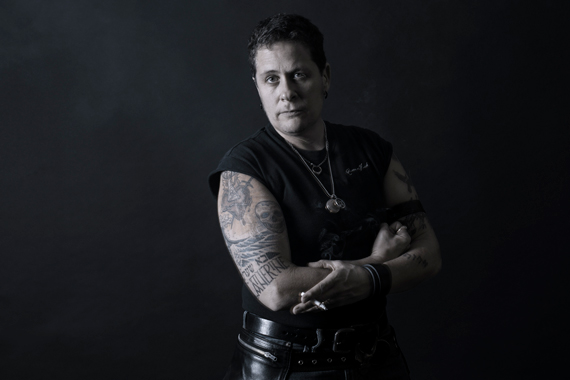
After years as a tribal councillor with the Siksika Nation, Adrian Stimson’s life changed when they took the plunge and applied to art school.

“I sort of asked myself that question, as I’m sure we all do, ‘What is it that I want to do when I grow up?,’” says Stimson, who uses the gender-neutral pronoun “they” in tribute to the Siksika language, which Stimson says has no gender-specific pronouns.

A residential school survivor, Stimson says art helped them deal with the trauma of that experience and the history of living on reserves.

“It allowed me to unpack and work through some of those issues that I faced while going through residential school, and the racism within the general public and the world, to create art that hopefully speaks to challenging a lot of those notions,” they explain.

Stimson is curating UnSettled, the visual arts portion of this year’s Queer Arts Festival.

After seven years as QAF’s artistic director, Shaira (SD) Holman decided to hand over this year’s festival to two-spirit curators and artists to coincide with Canada’s 150th year since Confederation.

“It was really important for the festival as a whole, rather than being a settler organization, to just step back and give over the entire curation,” Holman says.

QAF’s director of development, Rachel Iwaasa, says two-spirit curation is important because showcasing two-spirit art isn’t enough.

“We’re working with indigenous partners so that it’s not up to us to decide what constitutes an authentic indigenous, two-spirit representation,” Iwaasa says. “It’s important to us that we’re not the voices represented in the publicity.”

Stimson has curated the works of 17 established, novice and deceased artists for UnSettled in a bid to bring together and honour those who have been part of the collective history and being of two-spirit people.

Stimson hopes the artists’ work will challenge multiple narratives, including settler and heteronormative accounts. “I think it’s something that two-spirited artists do naturally and I think they continue to do.”

Adrian Stimson, curator of this year’s QAF visual arts exhibition, UnSettled. Courtesy Adrian A Stimson

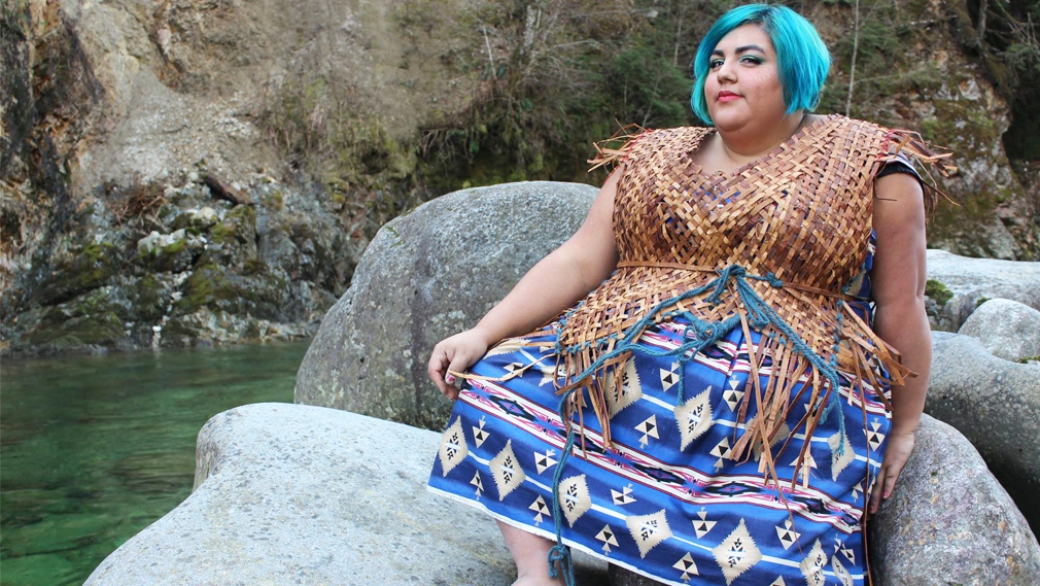
The work of Coast Salish and Stó:lō artist Raven John, whose ancestral name is Exwetlaq, will also feature at the festival. John says working as lead sculptor on Four Faces of the Moon, an animated short film, helped them through tragedy last year.

“It really is life-saving,” John says. “One of my aunts was murdered last year around February and it was a huge blow to our family. Having someone so close be added to this gross list of missing and murdered indigenous women was really hard for me.”

As a younger artist, John says they were interested in making “unreal worlds real through film.” Working on a feminist, indigenous film with a mostly indigenous and femme crew was “really life-affirming” in the midst of loss and the uncertainty of whether there would be justice for their aunt, John says. “It gave me an outlet to know there’s something better coming, there’s something better to strive for.”

Raven John’s painting, Two-Spirit Transformation Blessing, will be featured in UnSettled. Courtesy Raven John

Classically trained cellist Cris Derksen applauds Holman and Iwaasa for stepping back while indigenous artists take the curatorial lead. Derksen, who uses music as a way of criticizing appropriation and reconciling their own identity, will perform their Juno-nominated album Cris Derksen’s Orchestral Powwow at the festival.

Derksen says classical music has appropriated a lot of indigenous work. “As a classically trained indigenous human, I feel like this is a time that we can step up and say, ‘Hey, these are our songs, these are our stories, let us tell the story.’”

Noting their Cree and Mennonite heritage, Derksen says the album is a means of reconciling the various facets of their background and bringing them together in a way that allows the indigenous voice to be “heard loudly and respected.”
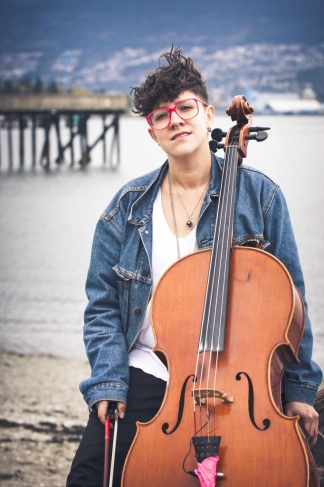
Classically-trained cellist Cris Derksen will be performing their album Cris Derksen’s Orchestral Powwow at this year’s QAF. Courtesy Cris Derken

Most chamber music has a conductor, Derksen observes. “I think it’s time that we listen to the aboriginal people first, so the beat of the drum dictates our show.”

John says that two-spirit inclusion needs to go beyond this year’s festival. “We need to address our histories, and one thing that I would love to see change in the arts community in general is that we don’t have to have an Indigenous or two-spirit exhibition,” they say. “We end up having women’s shows or queers shows or Indigenous shows or, in this case a two-spirit show, and as important as it is to increase awareness, we need to be included in other exhibitions.”

Holman says she’s committed to two-spirit inclusion beyond 2017.

“We don’t know yet that we have the funding  but we’re hoping to mentor more young queer, POC [people of colour], and especially two-spirit people in these kinds of positions so that it’s not just, ‘Oh yeah, 2017 we did this,’ and then we just moved on.”
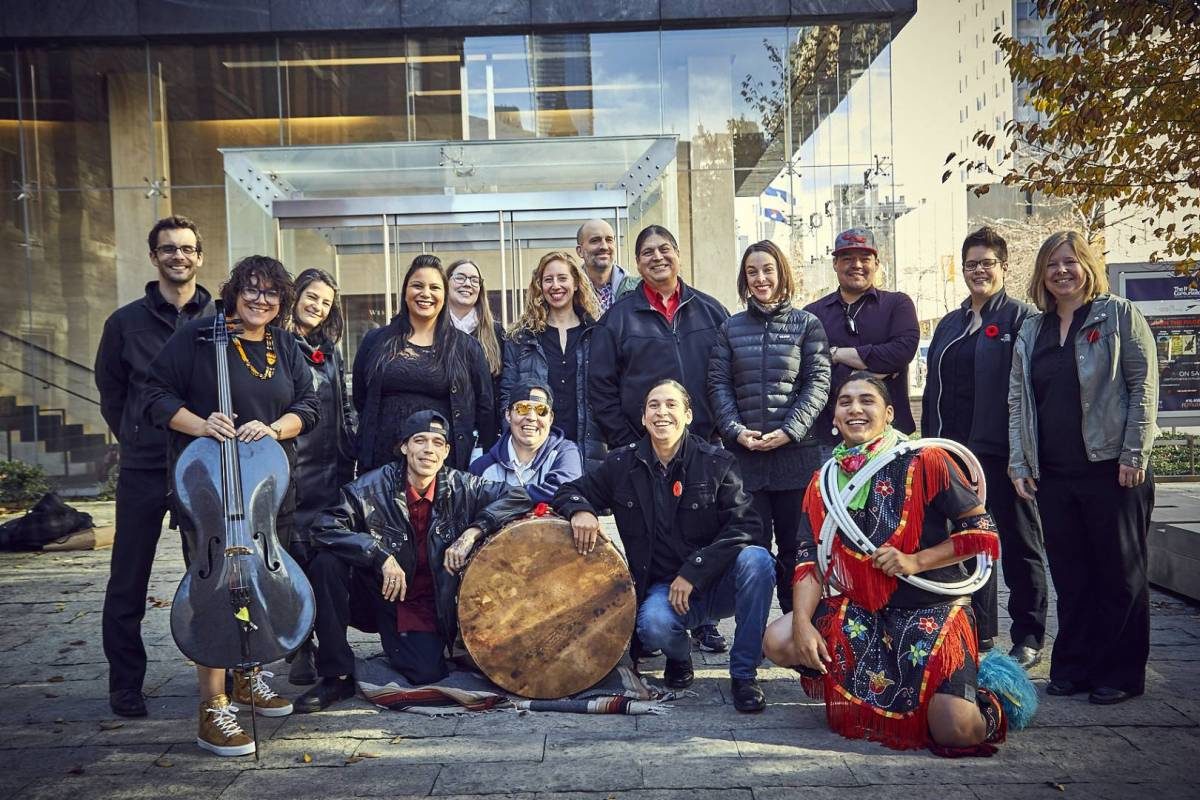
Vancouver’s Queer Arts Festival to highlight two-spirit and indigenous perspectives this year

Georgia Straight – Mar 6, 2017 – Craig Takeuchi

With the theme UnSettled, Vancouver’s Queer Arts Festival (QAF) announced today (March 6) that this year’s Queer Arts Festival will explore two-spirit viewpoints and issues through art.

In a statement on the QAF website, curator Adrian Stimson explains the visual arts exhibition will address the absence of two-spirit people and art from popular culture and that the artists will “expose the issues of historical extermination of two-spirit people, the lack of alternative aboriginal sexuality and gender in contemporary western culture/media, the two-spirit movement and future as a part of the reclamation of two-spirit identity and practice.”

Stimson also points out that homophobia was introduced to indigenous cultures through colonization.

“Two-thirds of the 200 Indigenous languages spoken in North America have non-negative terms to describe those who are neither male nor female, speaking to the primacy of multiple genders and sexualities within aboriginal cultures. Being identified as two-spirit often meant carrying unique responsibilities and roles within the community, knowledge keepers being one of the most important.

“Homophobia came with colonization, as the Urban Native Youth Association attests, ‘The religious dogma of the Residential Schools erased a proud and rich history of Two-spirit people in most Aboriginal communities. As a direct result of the residential school experience, homophobia is now rampant in most Aboriginal communities, even more so than in mainstream society.’ ”

George Littlechild

Several highlights at the festival will provide further exploration of two-spirit perspectives in a variety of media.

Musical elements will include the Chippewa Travellers and the Allegra Chamber Orchestra performing Cris Derkesen’s Orchestral Powwow on June 24.

A poetry and spoken-word event (June 26) will feature singer-songwriter Kinnie Starr, DJ O Show, and Tiffany Moses on June 26.

Online male hookup culture, fuelled by apps like Grindr, will be reflected upon in a dance piece by lemonTree creations entitled MSM [men seeking men] on June 20 and 21.

Dance works by Byron Chief-Moon and JP Longboat with Full Circle First Nations Performance will be paired together at Greed/Resolve, a program focusing on commerce, greed, and disenfranchisement, on June 27 and 28.

Greed/Resolve

Local curators June Scudeler and Lacie Burning, with Vancouver’s Indigenous Media Arts Festival, will present an evening of indigenous film, video, and new media art on June 23.

The festival will be held from June 17 to 29 at the Roundhouse Community Arts and Recreation Centre (181 Roundhouse Mews).

SD Holman Artistic Director of the Queer Arts Festival

Beatroute • Thursday 13th, April 2017 • by Kendell Yan

VANCOUVER – SD Holman has been a participating artist with Pride in Art (PiA) since its inception in 1998 as a volunteer-run community visual art show. In 2010, PiA rebranded as the Queer Arts Festival (QAF), has since then achieved charitable status, and is currently recognized as one of the top five of its kind across the globe. Besides being passionate about the environment and animal welfare, SD works with artists through QAF as the artistic director to promote visibility and respect for all of us who transgress sexual and gender norms with the transformative power of the arts.

BR: Can you describe your experience working with the Pride in Art Society as the Artistic Director of the Queer Arts Festival?

SD: When Two-Spirit artist Robbie Hong was ready to move on as the primary organizer, I stepped up. My goal was to ensure artists would be paid for their work; to become professional and support contemporary art — so the collective incorporated as a non-profit, expanded to become a festival open to all artistic genres, and began applying for grants. The funders told us we needed to hire paid staff to become ‘professional’, and the other artists nominated me. I protested — I’m learning disabled, and never thought of myself as an administrator — but they insisted that I was already doing the work, and a decade later, I’m still doing it, together with a fabulous crew of queer artist/administrators/activists.

I started work with the festival because there was no place for me as an artist. I wanted to provide a professional venue where art is presented in a queer context. Queer art is relentlessly discredited as too emotional or obsessed with sexuality, often dismissed as amateur, or unworthy of the definition of art itself. Art history is teeming with queers, but their identities as such are rarely acknowledged — even in retrospectives or obituaries of prominent queer artists today, their work is seldom contextualized as queer. This context is important, as composer Barry Truax wrote: “Art is said to mirror society, but if you look in the mirror and see no reflection, then the implicit message is that you don’t exist.” And queer teens — who are seven times more likely to attempt suicide than their straight peers — are clearly getting that message.

BR: How has this complemented/influenced your own artistic practice?

SD: In some ways, it’s eaten it alive. In others, it’s fed it — I have met, supported, and been supported by so many fascinating, talented artists through QAF, who have inspired me and sparked ideas. And QAF has helped grow a movement worldwide, so that there are more places now that consider my work seriously than there were in 1998.

BR: Can you tell me a little about UnSettled and the importance of decolonization and Indigenous Two-Spirit perspectives within the QAF? Within the LGBTQ2+ community at large?

SD: QAF 2017: UnSettled is a Two-Spirit curated festival. The term “Two-Spirit” is used by many Indigenous people in reclaiming and restoring traditional Indigenous concepts of gender, sexual, and spiritual identity — often inclusive of LGBTQ+.

Many contemporary queer struggles focus on changing the way our society thinks about gender — for example, the current battles around pronouns, or bathrooms. Yet how many people know that non-binary gender was once the norm here? Two-thirds of the 200 languages indigenous to this continent conceive of gender norms as having between three to six categories. These non-binary genders, and the people who identified with them, were brutally suppressed by colonial heteronormativity, especially through the residential school system.

So in 2017, as we look back on the last 150 years, we’re also asking what’s the best way to build a better future for queers? Amplifying the voices of Two-Spirit artists was for QAF the most relevant choice.

I invite a guest curator to select the artists for our visual art exhibition each year; for 2017, I expanded that practice to the other artistic disciplines as well. I’m delighted to present to Vancouver works brought to us by Adrian Stimson, Cris Derksen, Kinnie Starr, Full Circle First Nations Performance, and Vancouver Indigenous Media Arts Festival, to name a few of our partners.

BR: Are there any particular events/galleries you are most excited about for the upcoming festival this summer?

SD: I’m excited about every single event at the Queer Arts Festival, which runs from June 17–29, 2017.

But if I had to single out a few highlights, I’d particularly recommend:
UnSettled | June 17–29 
Two-Spirit Blackfoot visual art curator Adrian Stimson curates an exhibition of Indigenous work exploring Two-Spirit identity in Canada. Performance art curated by Stimson will take place at the opening Gala on Saturday June 17, 7–10 p.m.

MSM [men seeking men] | June 20 & 21 | 7 p.m.
A dance deconstruction piece by lemontree creations, inspired by online Grindr ‘hook-up’ culture.

Unsettling Colonial Gender Boundaries | June 23 | 7 p.m. | with VIMAF
Local curators June Scudeler and Lacie Burning program an evening of Canadian Two-Spirit film, video and new media art.

Cris Derksen’s Orchestral Powwow | June 24 | 7 p.m.
The Chippewa Travellers and the Allegra Chamber Orchestra perform cellist/composer Cris Derksen’s Juno-nominated composition.

Kinnie Starr, DJ O Show & Tiffany Moses | June 26 | 7 p.m.
Poetry and electronic music by Kinnie Starr, DJ O Show and Tiffany Moses, performing with guests from QAF’s young artist program.

Greed / REsolve | June 27 & 28 | 7 p.m. | with Full Circle First Nations Performance
Commerce, greed, and disenfranchisement are key themes in these two paired dance works by Byron Chief-Moon and JP Longboat.

BR: In your artist statement you start by discussing what you call “the dark pond” and end on a note about cognitive dissonance and paradox within your artistic framework. Does being queer inform your concerns with dissonant concepts?

SD:
The word “queer” by definition implies dissonance — it stems from the German “quer”, meaning oblique, or cutting across categories. As our 2016 visual art curator Jonathan D. Katz wrote: “Queerness works a seduction away from naturalized, normative and thus invisible ideological creeds, towards a position that is precisely other to, at a tangent from, social expectation. In deviating from social norms, queer art thus calls the viewer, of whatever sexualities, to an awareness of their own deviancy.”

I would be really happy to talk more about my own work at another time, in another interview. There’s a strong tendency, in looking at collaborations between Indigenous and non-Indigenous artists or arts organizations, to focus the lens on the non-Indigenous collaborators. So I’m deeply involved and deeply invested in UnSettled, as artistic director of QAF, but I’m not the story here.

However, I’ve been around long enough to know that if I answered interview requests with, “Don’t talk to me, talk to these artists instead,” the festival would likely just lose a lot of media coverage. But it feels not quite right, in the context of promoting UnSettled, to be publicizing my own work. I’d like to close instead with words by QAF’s visual art curator this year, Adrian Stimson:

“For too long, the absence of representations of Two-Spirit people, art, and being from contemporary popular culture has been equally embedded in hegemonic practices of colonization. With UnSettled I explore the art and being of Two-Spirit artists, and in turn, they expose the issues of historical extermination of Two-Spirit people, the lack of alternative aboriginal sexuality and gender in contemporary Western culture/media, the Two-Spirit movement and future as a part of the reclamation of Two-Spirit identity and practice.”
— Adrian Stimson

BR: Is there anything I haven’t addressed that you would like to speak about?

SD:
Start something.
Stop something.
Buy art, not drugs.
Change the world.

Share